
- Sale!
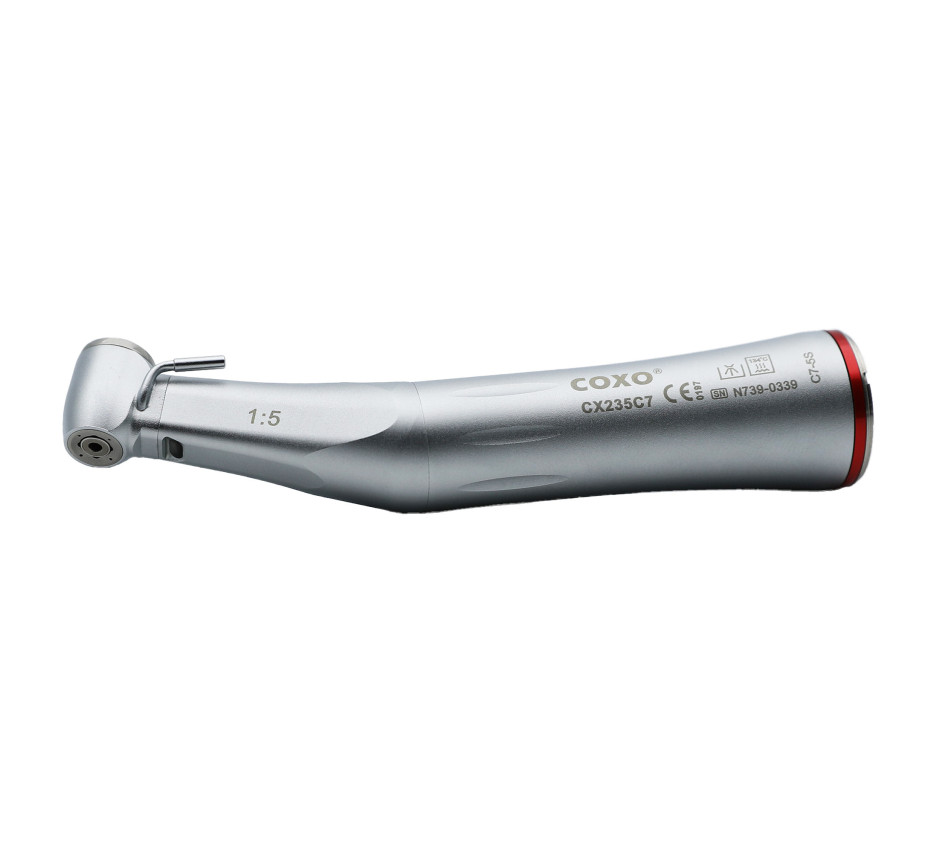
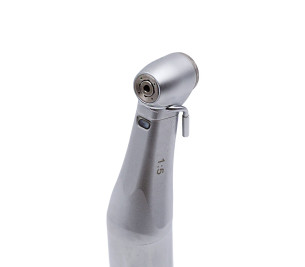
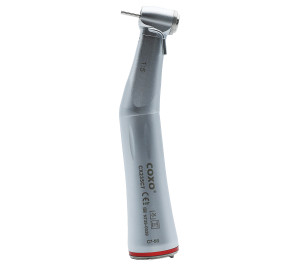
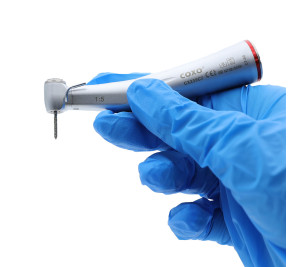
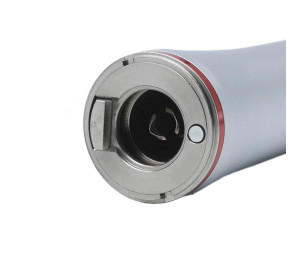
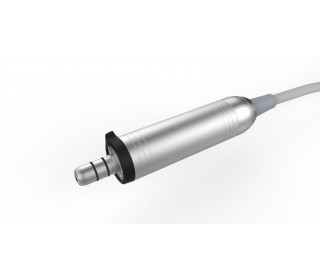
Improved version of the classic red contra-angle, but identical in size.
This red ring contra-angle has a rotation ratio of one to five.
It is fibre-optic (light)
External spray for implantology
It has a push button
You can find all models of Coxo dental contra-angles on DFC Instruments. To view this model and compare it with its variants, visit our dedicated category for red contra-angles.

This red contra-angle is an improved version of the classic red contra-angle C7-1. It nonetheless shares the same dimensions.
It features a new optical fibre, with a modified light angle, providing better visibility.
New gear design, significantly increasing its service life.
The spray is external, designed for external irrigation and for implantology.
New dust cover, further reducing fluid ingress into the contra-angle head and thus improving prophylaxis.
This new dust cover also helps to increase the rotor's service life by reducing its wear.
Works with 1.60 mm burs
Rotation ratio of 1 to 5
Equipment guaranteed for one year, parts and labour included, in accordance with our T&Cs (see the "Warranty" section).
HOW TO INCREASE THE SERVICE LIFE OF YOUR RED CONTRA-ANGLES
In a red contra-angle, the entire kinematic chain is made up of gears, from the entry of the contra-angle to its output (the bur). The red contra-angle increases the speed delivered by the micromotor, generally by a factor of 5 (one revolution at input, five at output), meaning that with a micromotor running at 40,000 rpm, the bur of a red contra-angle rotates at 200,000 rpm, i.e. more than 3,300 revolutions per second…. This is absolutely colossal. TO PUT THIS IN PERSPECTIVE, THIS MEANS THAT IN A SINGLE SECOND THE BUR ROTATES MORE THAN 3,300 TIMES…..
REGARDING LUBRICATION, unlike a car engine for example, a contra-angle has no oil reservoir. Lubrication must be applied continuously to reduce metal-on-metal friction, and thus prevent overheating, tearing of ball bearing material, gears… which signal the beginning of the end of the contra-angle.
Indeed, if a film of grease does not coat the moving parts such as gears and ball bearing balls, the materials will overheat, and metal will be torn away… The bearings will develop play, as will the gears; they will become noisy, the bur will not be held in its axis due to the play in the bearings. At this speed, vibrations will occur and it can even end with the explosion of a bearing and the scattering of micro balls…. or more commonly, broken gear teeth. That is it — the contra-angle is broken!
It is therefore very important to provide the necessary lubrication for the equipment to function correctly, and since there is no oil reservoir in the contra-angle, this should be done at every use, or in practice between each patient/sterilisation cycle…
We believe that from a lubrication standpoint, and especially for fast-rotating instruments, spray lubrication is preferable to automated machine lubrication. Or at the very least, before autoclave sterilisation, supplement the automated lubrication with a spray lubricant application.
Lubricate via the base of the instrument until the lubricant comes out through the head of the instrument. (Hold the instrument with the base facing up and the head facing down). If, when the product is ejected through the head, the lubricant comes out black or dark in colour, continue injecting until the product comes out clean/clear; this way you will have cleaned away the excess lubricant that has heated up during use. This allows the instrument to be lubricated and thoroughly cleaned at the very least. Once this is done, apply a little lubricant into the head through the bur insertion opening. This way you will have the assurance of perfect lubrication.
The problem with automated lubricators is that in principle they are perfect, but in practice, if for one reason or another the lubricant is not distributed correctly throughout the entire kinematic chain, there will be a lubrication failure leading to rapid deterioration of the instrument.
REGARDING THE USE OF THE EQUIPMENT
Although lubrication is important, it ultimately only slows down the wear of the equipment and materials… Since there is movement, there is friction and therefore wear. To reduce this wear, we believe there are two key points to respect. The first is speed, the second is the force applied to the equipment and the stress induced on the materials.
Simply put, the slower the equipment rotates, the slower it will wear. And the less pressure you apply to the bur, the less stress on the gears, and the slower they will wear.
Of course the equipment is made to work, but for example, operating with a micromotor at 25/30,000 rpm rather than at its maximum speed will greatly extend the life of the contra-angle. The same applies to the force you apply to the bur…
In order to achieve this, it seems important to us to work with unworn burs. If the bur cuts well, you will be able to reduce the motor speed and apply less force to cut. This way you can double the service life of the equipment.
Because one must not forget that a lower-quality, cheaper bur, but new or near-new, will always be more effective than an expensive premium brand bur that is worn….. Our advice is to use inexpensive but new or perfectly maintained burs rather than making expensive but worn burs "last", which in practice ultimately perform less well than low-cost burs….
Data sheet
Improved version of the classic red contra-angle, but identical in size.
This red ring contra-angle has a rotation ratio of one to five.
It is fibre-optic (light)
External spray for implantology
It has a push button
You can find all models of Coxo dental contra-angles on DFC Instruments. To view this model and compare it with its variants, visit our dedicated category for red contra-angles.