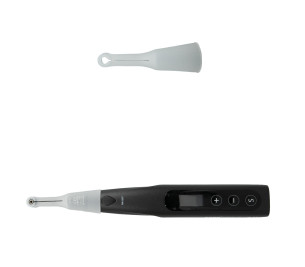

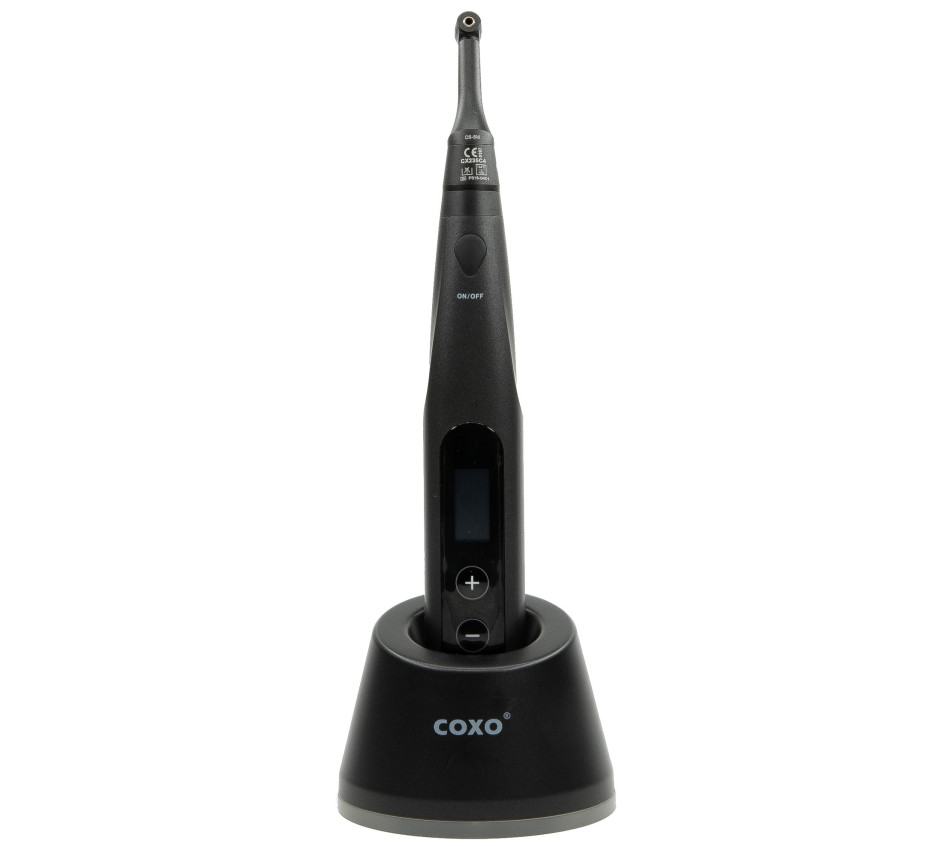
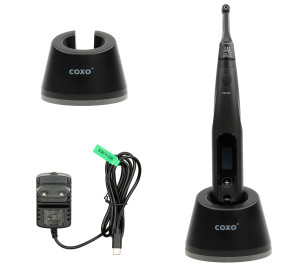

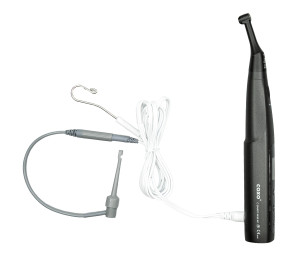
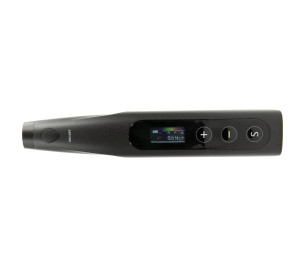
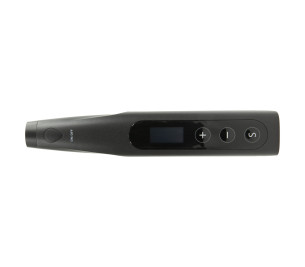
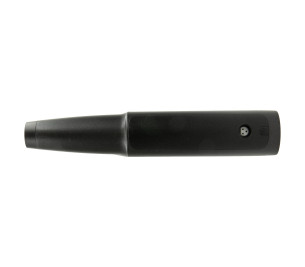
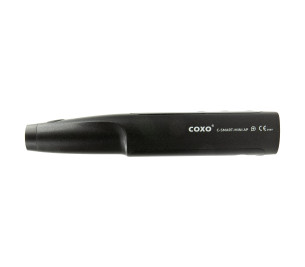
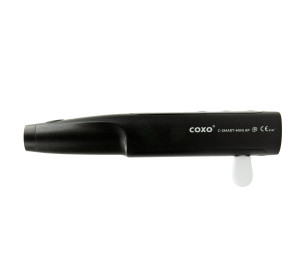
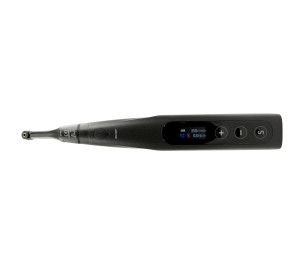
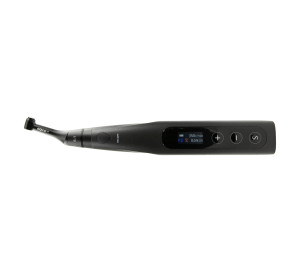
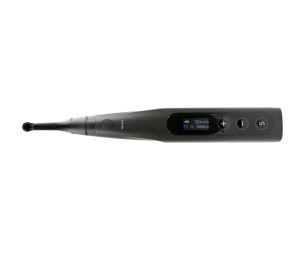
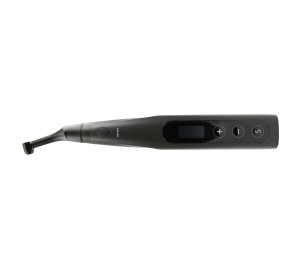
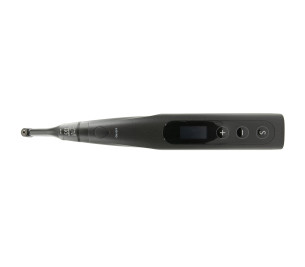
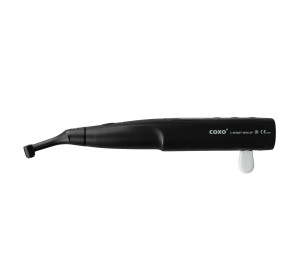
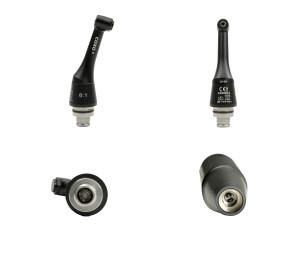
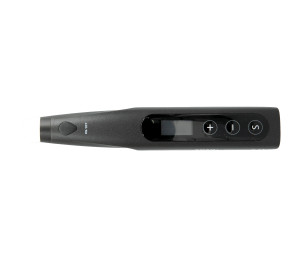
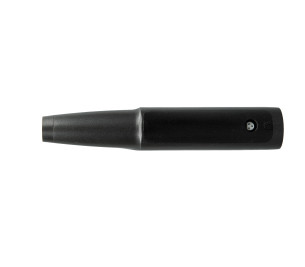
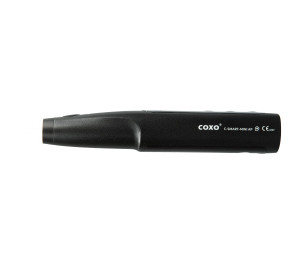
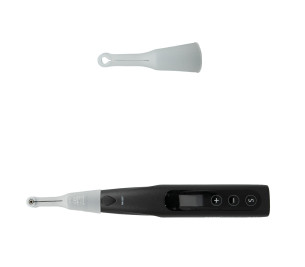
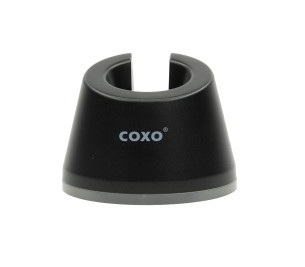
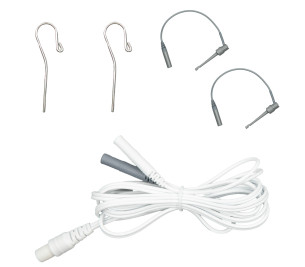
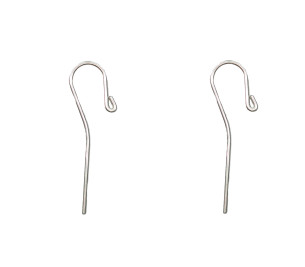
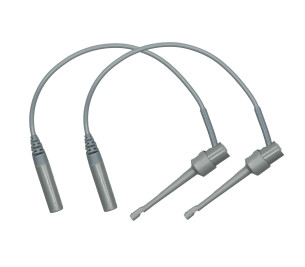
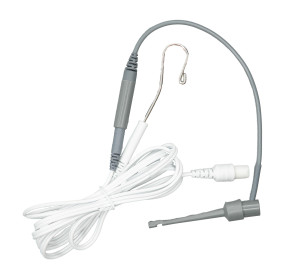
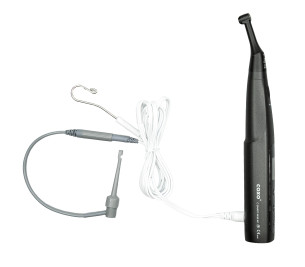
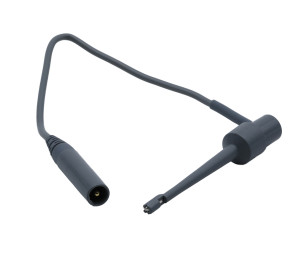
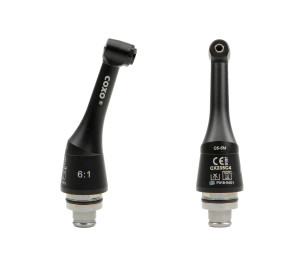
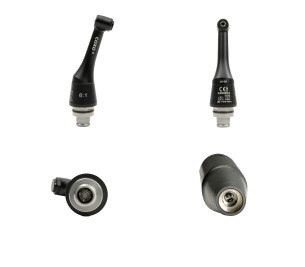
Portable endodontic motor coupled to an apex locator.
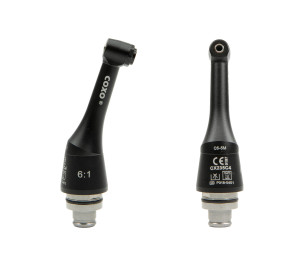
The head can be freely rotated to 360°.
Can operate as a standalone apex locator or as an endodontic motor coupled to the apex locator.
"Ledge removal" function for treating "complicated" canals with severe curvature.
"Tooth polish" polishing function
Instructions in French.
Warranty: Two years for the motorised handpiece. One year for the contra-angle, accessories, and six months for the battery.

This motor is the latest in the range of portable motors with apex locator from Coxo.
It has five functions/modes.
Endodontic motor only;
Has 9 adjustable programmes in endo mode. Continuous rotation, reciprocating, reverse. Speed and torque adjustable in continuous rotation.
In reciprocating mode, "forward" and "backward" rotation angles are adjustable. (This allows all types of files to be used in reciprocating mode.)
Possibility of adjusting the motor's action if the safety torque is reached. 1: the motor stops. 2: the motor switches to alternating rotation mode until the prescribed torque is reduced to 60% of its value, then resumes continuous rotation; in reverse mode until the prescribed torque is reduced to 60% of its value, then resumes continuous rotation.
Endodontic motor plus apex locator;
The endo motor function is identical to that in standalone operation. The apex locator function is here coupled to the endo motor. The "location" of the apex can be set higher or lower. The insertion depth of the file is visible on the screen and indicated by increasingly rapid beeps as the apex or the zone designated by the setting is approached. When the determined zone is reached, a continuous beep is emitted.
The motor's reaction when the foramen or the assigned zone is reached is the same as for the prescribed torque in endo mode. (Stop, reverse, reciprocating). In combined mode, the motor reacts to the first criterion exceeded (torque or apex).
Ledge removal;
This motor function is innovative. It is designed to assist the practitioner during canal preparation in the case of a complicated canal with a very pronounced curvature.
Explanation of the principle.
This is a very practical feature in modern root canal treatment, designed to address a common and difficult-to-treat clinical complication: the canal ledge.
What is a canal ledge?
During root canal preparation, due to canal curvature, and/or calcification and/or an inappropriate instrumentation technique (e.g., the use of rigid files with excessive force), the tip of the instrument fails to follow the original canal path. Instead, it carves an artificial "ledge" or "platform" on the canal wall that deviates from the natural anatomy. Once the ledge has formed, subsequent instruments become blocked on this platform and cannot reach the target apical length, resulting in incomplete cleaning and potential treatment failure.
The principle of the ledge removal function
Traditionally, ledge management relied largely on the clinician's tactile sense, experience, and patience. It involved repeated and delicate probing and actions using special manual instruments (e.g., small K-files, C-files, with an EDTA lubricant), which was very time-consuming, skill-dependent, and had variable success rates.
The "ledge removal" function of an endodontic motor considerably facilitates this process through an automated motion. Its basic principle can be summarised as follows:
« An automated probing motion, practising small alternating rotations at equal angles, designed to guide the tip of the instrument beyond or through the ledge in order to reposition and re-canal the original root canal path. »
The specific implementation generally involves the following key technical aspects:
Special motion (alternating rotation at equal angles):
This is not a standard reciprocating rotation (which has different rotation angles). The motor commands the instrument to perform alternating rotation at equal angles (ranging from 30 to 330°, adjustable in 10° increments). It is advisable to work with small angles in order to greatly reduce the risk of file fracture or deviation from the endodontic canal.
Objective: this motion reduces the risk of the instrument becoming "caught" on the ledge or causing a lateral cut that worsens the situation. The alternating motion mimics the manual "watch-winding" movement, which is the most effective mechanical motion for bypassing ledges.
In this mode, it is advisable to run the motor at a slow speed (e.g., 100–150 rpm), as well as with a small angle (30/40°, for example).
Configured in this way, the motor allows the practitioner to focus more on their touch to guide the instrument, and thus resolve ledge problems more safely and effectively.
In brief, the Ledge Removal function = provides the clinician with a "smart handpiece" or "stabiliser" to manage ledges. It controls the instrument so that it performs the most appropriate "probing action", while the clinician focuses on "finding the path".
Tooth polish
This mode has 4 programmes. Five speeds are adjustable: 500, 1000, 1500, 2000, 2500 revolutions per minute.
The programme is designed for polishing.
System setting;
In this mode, you can change the display orientation (for left-handed users), activate the contra-angle auto-calibration system, set the time before automatic standby, select the motor's behaviour when the selected apical zone is reached by the file tip (stop, reverse, reciprocating), enable/disable automatic motor start mode when the file enters the canal, enable/disable automatic speed reduction as the file tip approaches the selected apical zone.
The contra-angle is autoclave-sterilisable; instructions in French.
Warranty: Two years for the motorised handpiece. One year for the contra-angle, accessories, and six months for the battery.
Data sheet
Portable endodontic motor coupled to an apex locator.
The head can be freely rotated to 360°.
Can operate as a standalone apex locator or as an endodontic motor coupled to the apex locator.
"Ledge removal" function for treating "complicated" canals with severe curvature.
"Tooth polish" polishing function
Instructions in French.
Warranty: Two years for the motorised handpiece. One year for the contra-angle, accessories, and six months for the battery.