
- Sale!
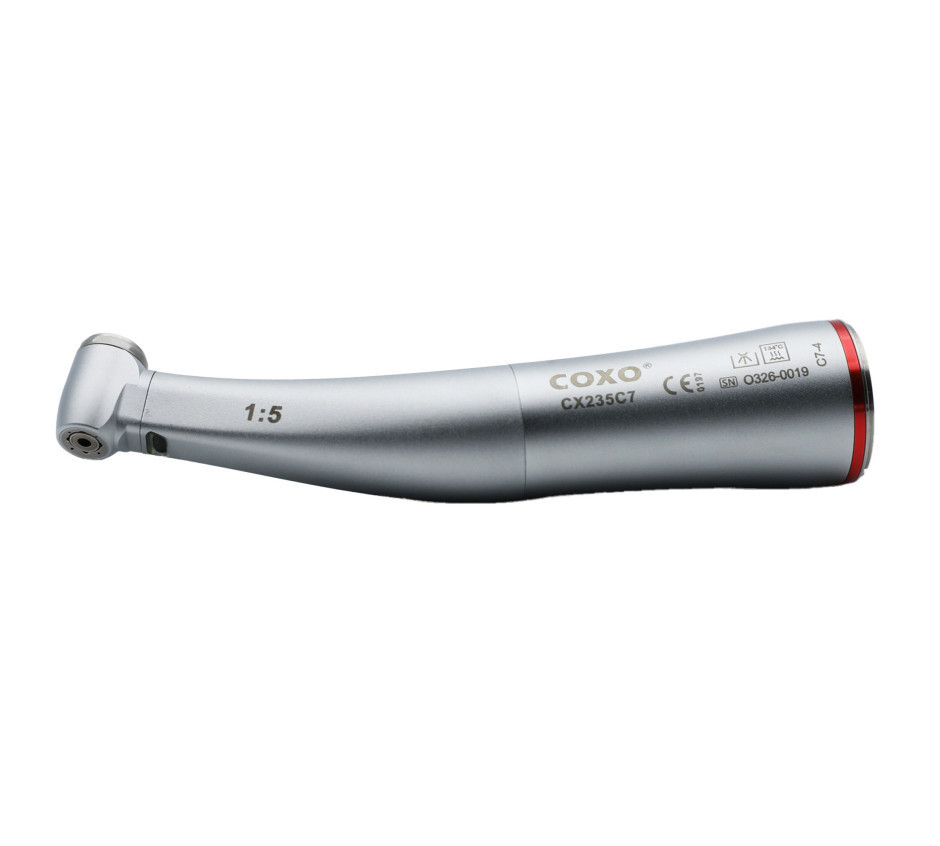


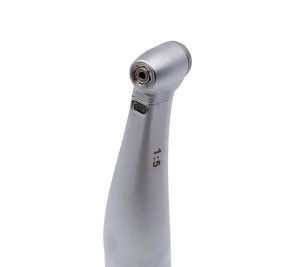
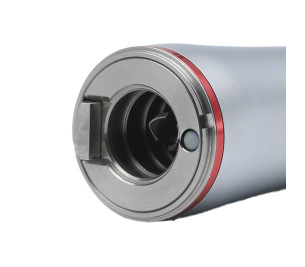
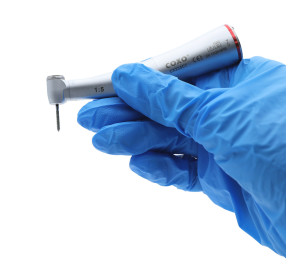
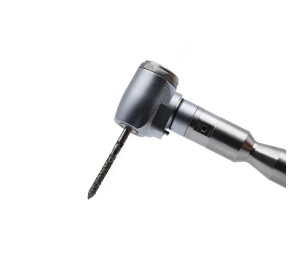
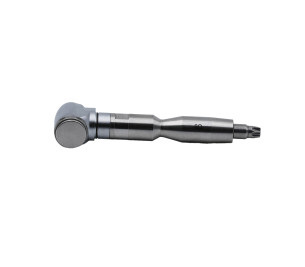
Coxo red contra-angle, version with a head of smaller diameter than the standard head.
This red-band contra-angle has a rotation ratio of one to five.
Ceramic ball bearing.
It is fibre-optic (light)
It has four spray ports.
It has a push button
Browse the complete selection of dental contra-angles Coxo available on DFC Instruments. Also see the red contra-angle category to discover this model and other similar ones

This red-band contra-angle works with 1.60 mm burs
Rotation ratio of 1 to 5
The head diameter is reduced; it goes from 10 mm on the standard contra-angle to 8.9 mm on this model.
The contra-angle angle is modified. It goes from 90° to 92°, which improves work on posterior teeth.
The light projection angle has been improved, which enhances visibility.
The rotor is equipped with a dust-proof system that protects the rotor and increases its lifespan, as well as reducing liquid penetration inside the head, which improves prophylaxis.
And above all, the rotor ball bearings are ceramic, which greatly increases the lifespan of the contra-angle.
As with other contra-angles, the equipment is guaranteed for one year, parts and labour included, in accordance with our T&Cs (see the "Guarantee" section).
VIDEO TUTORIAL: HOW TO REPLACE THE HEAD YOURSELF
Rather than sending the contra-angle back to us for after-sales service, you can very advantageously replace the contra-angle head yourself. 9 times out of 10, it is the head rotor pinions that are damaged. By replacing the head, you avoid the labour costs of after-sales service as well as shipping costs. Equipment repair times are shortened as shipping delays and after-sales service processing times are avoided.
HOW TO INCREASE THE LIFESPAN OF YOUR RED CONTRA-ANGLES
In a red-band contra-angle, the entire kinematic chain is made up of gears. From the input of the contra-angle to its output (the bur). The red contra-angle increases the speed driven by the micromotor generally by a factor of 5. (one revolution at input, five at output), which means that with a micromotor running at 40,000 rpm, the bur of a red contra-angle rotates at 200,000 revolutions per minute, or more than 3,300 revolutions per second…. That is absolutely colossal. TO PUT THIS IN PERSPECTIVE, THIS MEANS THAT IN JUST ONE SECOND THE BUR ROTATES MORE THAN 3,300 TIMES…..
REGARDING LUBRICATION, unlike a car engine for example, a contra-angle has no oil reserve. It is essential to continuously provide the necessary lubrication to reduce metal-on-metal friction, and thus avoid overheating, tearing of material from ball bearings, gears… which signal the beginning of the end for the contra-angle.
Indeed, if a greasy film does not coat the moving parts such as gears / ball bearing balls, the materials will overheat, then metal will be torn away… . The bearings will develop play, as will the gears, they will become noisy, the bur will not be held on its axis due to the play in the bearings. At this speed this will cause vibrations and may even end in the explosion of the bearing with dispersion of the micro balls…. or more classically the breaking of gear teeth. That's it, the contra-angle is broken!
It is therefore very important to provide the necessary lubrication for the equipment to function properly, and since there is no oil reserve in the CA, this must be done at every use, or in practice between each patient/sterilisation cycle…
We believe that from a lubrication standpoint, and especially for high-speed rotating instruments, spray lubrication is preferable to automated machine lubrication. Or at the very least, before autoclave sterilisation, supplement the automated lubrication with a spray lubricant injection.
You must lubricate through the base of the equipment until the lubricant comes out through the head of the instrument. (Hold the instrument with the base facing up and the head facing down). If when the product is ejected through the head the lubricant comes out black or dark in colour, continue injecting until the product comes out clean/clear; this way you will have removed the excess lubricant that has heated up during use. This at least lubricates and thoroughly cleans the instrument. Once this is done, add a little lubricant into the head through the bur insertion hole. This will ensure perfect lubrication.
The problem with automated lubricators is that in principle they are perfect, but in practice, if for any reason the lubricant is not distributed properly throughout the entire kinematic chain, you will have a lubrication deficiency leading to rapid deterioration of the instrument.
REGARDING THE USE OF THE EQUIPMENT
Although lubrication is important, it ultimately only slows down the wear of equipment and materials… Since there is movement, there is friction and therefore wear. To reduce this wear, we believe there are two key points to respect. The first is speed, the second is the force applied to the equipment and the stress induced on the materials.
In short, the slower the equipment runs, the less quickly it will wear. And the less force you apply to the bur, the less force on the gears, and the less they will wear.
Of course the equipment is designed to work, but for example, running a micromotor at 25,000/30,000 rpm rather than at its maximum speed will greatly extend the life of the contra-angle. The same applies to the force you apply on the bur…
In order to be able to do this, it seems important to us to work with unworn burs. If the bur cuts well, you will be able to reduce the motor speed and apply less force to cut. This way you can double the lifespan of the equipment.
Because it should not be forgotten that a lower-quality bur, less expensive but new or nearly new, will always perform better than an expensive premium brand bur that is worn….. Our advice is to use inexpensive burs that are new or in perfect condition rather than making expensive but worn burs "last", which in practice ultimately perform worse than low-cost burs….
Data sheet
Coxo red contra-angle, version with a head of smaller diameter than the standard head.
This red-band contra-angle has a rotation ratio of one to five.
Ceramic ball bearing.
It is fibre-optic (light)
It has four spray ports.
It has a push button
Browse the complete selection of dental contra-angles Coxo available on DFC Instruments. Also see the red contra-angle category to discover this model and other similar ones