Dental Turbine
Are you a dental surgeon looking for a reliable and high-performing tool to simplify your dental practice?
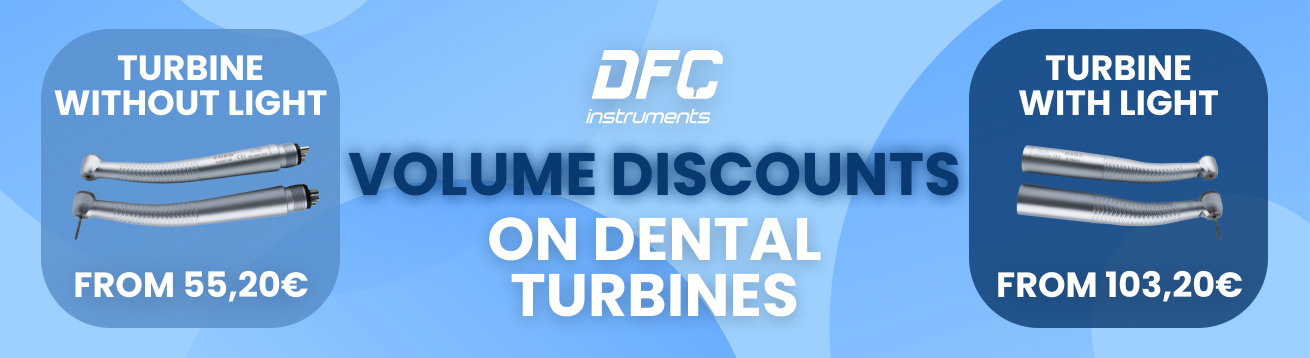
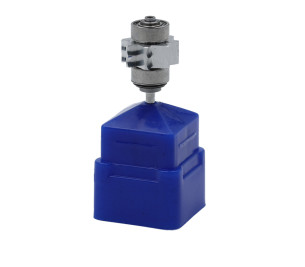
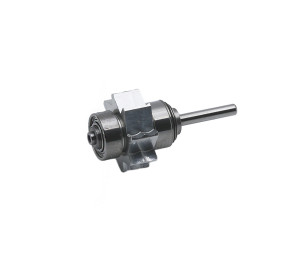
A dental turbine is an instrument used by dental surgeons to carry out various procedures on teeth. This equipment, which operates at very high speed thanks to a mechanism driven by compressed air, enables rapid and precise removal of dental plaque, cavities…
The dental turbine is often associated with a water and air cooling system to minimise the heating of surrounding tissues and ensure patient comfort. The dental surgeon can adjust the speed and power of this instrument according to the specific needs of each procedure.
A compact and ergonomic tool
The size of a dental turbine can vary, but generally it is designed to be
compact and ergonomic in order to facilitate handling by the dental surgeon. The length of a standard dental turbine is approximately 12 to 15 centimetres, and it generally weighs between 50 and 100 grams. These dimensions allow a good grip and precise control during dental treatments.
Quick and comfortable to handle
The grip of the turbine is an important aspect for practitioner comfort. Dental turbines are often fitted with a non-slip coating or grooves to ensure better grip. Furthermore, some turbines are equipped with an integrated suspension system that reduces vibrations and noise generated by high-speed operation, thus contributing to a more pleasant experience for both the dental surgeon and the patient. Finally, the ergonomic design of dental turbines allows professionals to work efficiently and without excessive fatigue over long periods.
Coxo Dental Turbine
Coxo dental is one of the most reputable brands in the dental field. The Coxo dental turbine is designed to offer a precise and comfortable cutting experience. The turbine can rotate at speeds of up to 320,000 revolutions per minute, operating with compressed air at approximately two bar. Equipped with a cooling system to prevent overheating. It is also lighter than some traditional turbines, which reduces muscle fatigue and improves practitioner comfort.
Several dental turbine models are available to meet the specific needs of each dental practice. The most common models include the standard head turbine and the large head turbine. Both models are equipped with a cooling system to prevent overheating. Some turbines are fitted with an angled head to facilitate the dental surgeon's work during treatments.
Turbine Heads
Dental turbines can be fitted with different heads to suit various procedures and specific needs. Here are some commonly used head types and their uses:
- Standard head: The standard head is the most commonly used and is suitable for most basic dental procedures, such as cavity preparation and dental plaque removal. It is versatile and offers good visibility for the dental surgeon.
- Reduced head: The reduced head is smaller than the standard head, allowing access to difficult-to-reach areas, such as posterior teeth. It is useful for precision treatments and procedures on children, whose mouths are often smaller.
- Angled head: This head features a specific angle that facilitates access to less accessible areas of the mouth, such as the occlusal surfaces of posterior teeth. It is often used for scaling and cleaning of periodontal pockets.
- Large head: The large head is more voluminous than the standard head and offers higher torque. It is used for procedures that require greater cutting power, such as rapid reduction of dental structure or prosthetic preparation. The large head also allows better heat dissipation, thus reducing the risk of overheating of surrounding tissues. However, due to its size, it may offer reduced visibility in certain areas of the mouth and is not suitable for all procedures.
What is the difference between a dental turbine and a dental contra-angle?
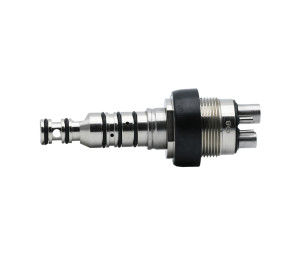
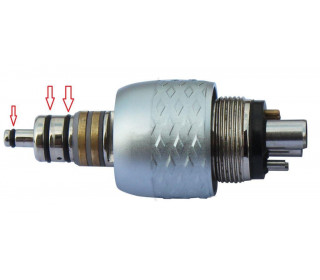
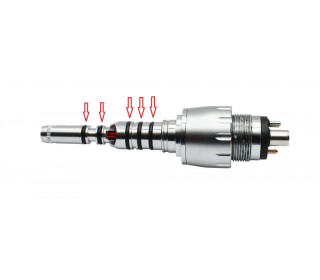
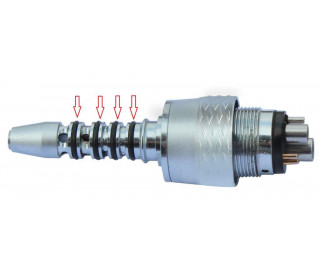
The main difference between a dental turbine and a dental contra-angle is its mode of operation. The dental turbine is driven by compressed air and is connected directly to the dental chair tubing or via a quick-release connector. For its part, the dental contra-angle is attached to a micromotor that greatly increases the power of the cutting equipment.
Other differences: Ergonomics and power
Turbines are lighter and less expensive than contra-angles, but they cannot achieve the same power. Contra-angles are heavier, but they are more powerful thanks to the power conferred by the micromotor. Both instruments are used to remove dentine, polish teeth, prepare cavities and crowns, remove fillings and carry out endodontic or implantological treatments.
Here is a summary table of the various useful comparison points to differentiate one from the other:
| Criteria |
Dental turbine |
Dental contra-angle |
| Mode of operation |
Driven by compressed air, connected directly to the dental chair tubing or via a quick-release connector. |
Attached to a micromotor, with a gear system increasing the power of the cutting tool. |
| Weight |
Lighter |
Heavier |
| Cost |
Less expensive |
More expensive |
| Speed |
Superior |
Inferior |
| Power |
Less powerful |
More powerful |
| Applications |
Dentine removal, polishing, cavity and crown preparation, filling removal, endodontic and implantological treatments |
Dentine removal, polishing, cavity and crown preparation, filling removal, endodontic and implantological treatments |
| Speed control |
Less control, constant speed |
More control, variable speed |
| Cooling |
Internal water spray |
Internal or external water spray |
| Maintenance |
Easier maintenance, simpler to lubricate |
More maintenance, requires regular lubrication of the gears |
| Ergonomics |
More suited to short and rapid procedures |
More suited to prolonged procedures requiring power. |




 Dental Stripping